Email: ademaj@uni.coventry.ac.uk

Janneke Adema (she/her) is a cultural and media theorist working in the fields of (book) publishing and digital culture. She is an Associate Professor in Digital Media at the Arts and Creative Cultures (ArCC) research centre at Coventry University. She previously convened the Post-Publishing Research Strand. In her research she explores the future of scholarly communications and experimental forms of knowledge production, where her work incorporates processual and performative publishing, radical open access, post-publishing, scholarly poethics, media studies, book history, cultural studies, and critical theory. She explore these issues in depth in her various publications, but also by supporting a variety of scholar-led, not-for-profit publishing projects, including the Radical Open Access Collective, Open Humanities Press, Post Office Press (POP), and the Copim community. She is Co-Investigator on the Research England, Wellcome Trust, and AHRC funded Materialising Open Research Practices in the Humanities and Social Sciences (MORPHSS) project. She was PI and Co-Investigator on the Research England and Arcadia funded COPIM and Open Book Futures project, where, together with the Copim Experimental Publishing Group, she supports several experimental book publishing pilot projects and maintains the Experimental Publishing Compendium. She is also a co-editor (together with Dr Alyssa Arbuckle) of the Journal of Electronic Publishing.
She previously convened the Post-Publishing research strand, which gathered together researchers and practitioners who, both collaboratively and individually, explore alternative pasts, presents, and futures for publishing. From 2019 to 2022, the strand hosted a series of symposia exploring contemporary approaches to experimental publishing.
Her background is in Media Studies (PhD, Coventry University), History (MA), Philosophy (MA) (both University of Groningen), and Book and Digital Media Studies (MA, Leiden University). She has previously conducted research for Jisc, The Knowledge Exchange, and DOAB, and has worked on the OAPEN project, subsequently the OAPEN foundation, from 2008 until 2013 (including research for OAPEN-NL). Her research for OAPEN focused on user needs and publishing models concerning Open Access books in the Humanities and Social Sciences.

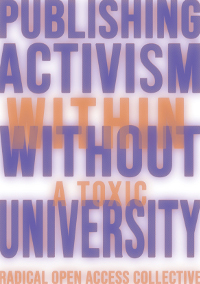
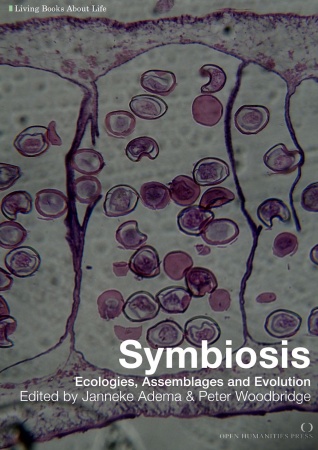

in 2025 she co-edited, together with the Radical Open Access Collective co-convenors, Publishing Activism within/without a Toxic University (Coventry: Post Office Press (POP) and Open Humanities Press). She co-authored Públicos Fantasma – La Naturaleza Política Del Libro – La Red (Mexico: Taller de Ediciones Económicas, 2016) together with Andrew Murphie, Gary Hall, and Alessandro Ludovico and has co-edited a living book on Symbiosis together with Pete Woodbridge (Open Humanities Press, 2011) and a liquid book together with Gary Hall on the data-driven world of social networking: Really, We’re Helping To Build This . . . Business: The Academia.edu Files (London: Open Humanities Press, 2016). She is currently working on a monograph on Experimental Publishing. She has published in among others Culture Unbound; Culture Machine; New Formations; Convolution; Cultural Studies; The International Journal of Cultural Studies; New Media & Society; New Review of Academic Librarianship; Krisis. Journal for Contemporary Philosophy; the Journal of Electronic Publishing, The Journal of Media Practice; Insights; Liber Quarterly; LOGOS. The Journal of the World Book Community; andWestminster Papers in Communication and Culture.
Her monograph Living Books, Experiments in the Posthumanities (MIT Press, 2021), critically explores: how knowledge is created (produced, distributed, and consumed); how we as scholars are involved in knowledge creation; and how we can create alternatives to the present system. In doing so it focuses on the function of the academic author, the political-economy of scholarly book publishing, and the stability and fixity of the scholarly book object. Adema’s analysis consists of an exploration of publishing experiments that engage with collaborative, anonymous and remixed authorship, open access publishing and open peer review, and liquid, living and remixed scholarship. She argues that even those who are lobbying for a shift to a more open, digital book, almost invariably end up replicating many of the features associated with print (for reasons of stability, authority, quality etc.). A large part of the originality of her project lies with the way it constitutes both a theoretical and practical intervention in the debate on the future of the book. Through a methodology of ‘critical praxis’, Adema performed and continues to perform her book in an alternative, digital, and open way, like she does here on Open Reflections. Her research can be followed online as it develops, and features a variety of different, remixed, multimodal and multi-platform versions. In other words, it constitutes a performative and interventionist approach, where through experimentation she actively critiques and rethinks ‘natural’ communication practices, to explore to what extent an open online book is possible that does not simply replicate the printed codex book.
- Reviews about Living Books:
Georg Fischer, Rezension: Adema, Janneke: Living Books. Experiments in the Posthumanities, Cambridge, MA 2021. H-Soz-Kult, 14.03.2024, https://www.hsozkult.de/publicationreview/id/reb-11581
Book notes: Living Books: Experiments in the Posthumanities, European Journal of Communication, 36(5), 2021, 543-544, https://doi.org/10.1177/02673231211045280d
Elena Maceviciute, Review of: Adema, Janneke. Living books: experiments in the posthumanities. Cambridge, Mas: MIT Press, 2021. Information Research, 27(2), 2021, review no. R739, http://www.informationr.net/ir/reviews/revs739.html
Alyssa Arbuckle, ‘On Living Books By Janneke Adema’, October 26 2021, https://alyssaarbuckle.com/2021/10/26/on-living-books-by-janneke-adema/
- Interviews/book talks about Living Books:
Erzsébet Tóth-Czifra, Janneke Adema: ‘Reimagining the past and future of academic books: interview with Janneke Adema, author of Living Books,’ in DARIAH Open, October 18 2021, https://dariahopen.hypotheses.org/?p=1128. Also online in the margins of Living Books here: https://livingbooks.mitpress.mit.edu/pub/35x6zq2o/release/1
Jeroen Sondervan, Open Access Books Network (2021). OA Books Workouts, episode 1. Interview with Janneke Adema. Zenodo. https://doi.org/10.5281/zenodo.5607029.
Sarah Kearns, Podcast interview with Janneke Adema, ‘Living Books. Experiments in the Posthumanities’, 2021, for New Books Network podcast: https://newbooksnetwork.com/living-books.
Invited Book Talk with Kevin Wisniewski, Textshop Experiments, November 4 2021: http://textshopexperiments.org/booktalks
Invited Book Talk with Jeroen Sondervan, OA Books Workouts. Scholars At Work – Open Access Books Network, October 19 2021.
Invited Keynote, ‘Post-Publishing: Experimenting with Living Books’, The Digital Afterlives network, Cambridge Digital Humanities (CDH), University of Cambridge, https://www.crassh.cam.ac.uk/events/33821/ part of the Unbind: Reimagining the Academic Monograph Symposium https://www.crassh.cam.ac.uk/events/34056/, Cambridge June 10 2022.
Living Books was selected as a case study by UKRI to share experiences of publishing academic books open access:
- Announcement: https://www.ukri.org/news/progressing-open-access-for-books-at-ukri/
- Zenodo record with all the case studies: https://zenodo.org/records/13944972
- Zenodo record with materials on Living Books: https://zenodo.org/records/14733731
- Articles/Blogposts promoting/accompanying Living Books:
Janneke Adema, ‘The Processual Book. How Can We Move Beyond the Printed Codex?’, LSE Impact Blog, January 10 2022, https://blogs.lse.ac.uk/impactofsocialsciences/2022/01/10/the-processual-book-how-can-we-move-beyond-the-printed-codex/ Republished by the LSE Review of Books: https://blogs.lse.ac.uk/lsereviewofbooks/2022/01/21/the-processual-book-how-can-we-move-beyond-the-printed-codex/
Janneke Adema, ‘Versioning and Iterative Publishing,’ Commonplace, 2021, https://doi.org/10.21428/6ffd8432.42408f5b
Janneke Adema, ‘Publishing my book OA will not advance my career.’ Open Access Books Network OA Mythbusters series, Feb 9 2022, https://youtu.be/0Er13w9Bpg4